Lisnevin
Say NothingLisnevin was a secure residential facility for boys near Newtownards whose high fences, alarm system and solitary-confinement rooms made it resemble a detention institution more than a school. Yet for Michael McConville, sent there after repeated attempts to escape other placements, its containment brought an unexpected measure of stability. He came to love the place, kept clear of its sectarian skirmishes and found care in the friendship of Sister Frances. Lisnevin’s importance lies in this contrast: a locked institution could offer a motherless child a place to settle, but it could not prepare him for life beyond its gates.
Setting and Design
Lisnevin had recently been established as a secure residential facility for boys, despite protests from the surrounding community. Calling it a school softened what it was: a juvenile detention setting for boys considered too rough or wilful for institutions such as the De La Salle Boys’ Home at Kircubbin. Its residents included serial escapees like Michael, as well as adolescents arrested for burglary, assault and paramilitary activity. The facility brought together boys already marked as difficult by the institutions and authorities around them.
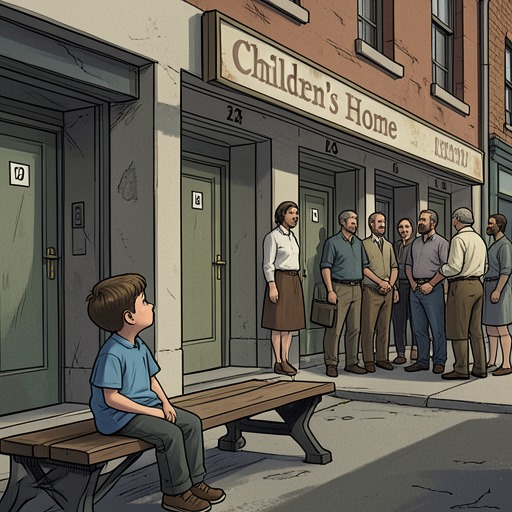
The main building was a converted mansion, once the centrepiece of a grand country estate. Its imposing past sat uneasily beside its present use. Inside were isolation rooms: bare cells stripped of furniture, with barred windows, where children who had broken rules could be confined alone. Around the property stood a tall perimeter fence, electrified and connected to an alarm that sounded if anyone tried to escape. These were not incidental details of the setting. The architecture made surveillance and confinement part of daily life, even as staff maintained that the fences were there to keep people out rather than keep residents in.
Michael McConville’s Arrival
Michael arrived after a sequence of removals prompted by his repeated escapes. Following his mother’s disappearance, he had been taken from the family flat in Divis and placed in care; he repeatedly slipped away and ran back to West Belfast. He had already lived through more than one institutional setting, and the transfer to Lisnevin was another response to a boy whom authorities found difficult to contain. For Michael, however, the new placement did not feel simply like a further punishment. He later joked that Lisnevin was the best home he had ever had.
That response is striking beside the place’s formidable security. Michael valued Lisnevin, even with its isolation rooms and electrified boundary, and the account suggests that the facility gave him room to settle after the dislocation and distress surrounding his mother’s disappearance. Its distance from Belfast and its controlled grounds may have made it feel like a refuge from the turmoil he had known, though the institution remained a place of enforced rules and restricted movement. The paradox is central to Lisnevin’s significance in his story: a secure facility could be both a form of confinement and, for a time, a home.
Community and Care
Lisnevin was nondenominational, but religious difference did not disappear within its walls. Catholic and Protestant residents were regularly involved in sectarian skirmishes. Michael steered clear of these conflicts. The fact that he avoided trouble does not mean the tensions were absent; they formed part of the social environment in which he had to find his bearings. The institution’s security enclosed a mixed community without resolving the divisions that shaped it.
One relationship offered Michael a more personal kind of protection. He got to know Sister Frances, a kindly nun who looked out for him and also befriended his siblings. Her care extended beyond his stay: even after she moved to America, she continued to send the McConville children Christmas cards with a dollar bill folded inside. The gesture was small, but it endured. For children whose mother had disappeared and whose family life was fragmenting, the annual cards provided a continuing sign that someone remembered them and remained connected to them.
Departure and Significance
Michael could leave Lisnevin on weekends, like a prison furlough, and return to Belfast to stay with Archie or Helen. During these visits the siblings did not speak about what had happened to their mother; it was too painful. Their shared family identity was eroding, and they were increasingly left to fend for themselves. Lisnevin therefore did not reunite the family or give Michael a way to address the loss. It offered a place to live within the rupture, while his weekend journeys brought him back to the siblings with whom that rupture was shared but rarely discussed.
When Michael turned sixteen, he left Lisnevin to look for work and somewhere to live. By then, he had spent nearly a third of his life in institutions. The transition was abrupt: no one taught him how to rent a flat, find a job or boil an egg. The door simply opened, and he was expected to manage. Lisnevin had given him a setting in which he could settle and a relationship with Sister Frances that outlasted his placement, but its care ended without preparing him for ordinary independence. In Michael’s trajectory, the institution is both a rare refuge and a threshold: a secure place that helped him endure childhood, followed by an exit into adult life for which he had been left largely unprepared.